
 Image 1 of 2
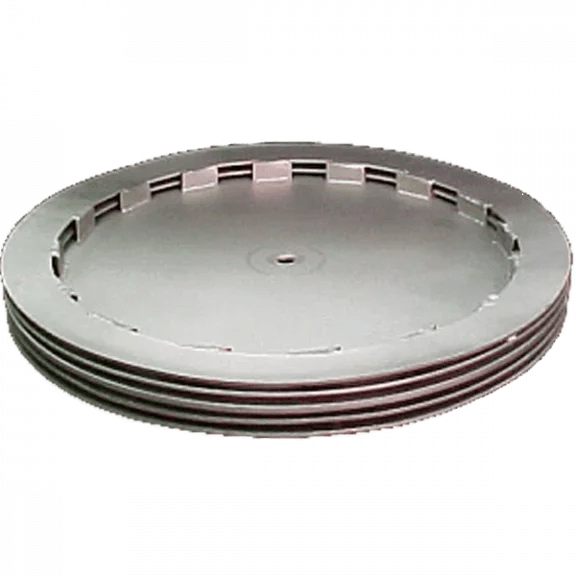 Image 2 of 2
Hockmeyer offer a variety of blades including their own design D blade which is great for high shear
applications and for use with materials that are difficult to wet in. The Blade, also known as the ring
blade, is a powerful tool for optimizing disperser performance, sizes from 2” to 30” diameter.
It consumes more horsepower than the saw tooth blade, typically runs at higher tip speeds (5700 + fpm)
and performs more like a rotor stator. You may be asked for some machine specifics if interested in this
blade, due to the demand for more horsepower and higher tip speeds. Much of the ring blade's work is
done hydraulically as centrifugal force drives the product between the contoured rings. This creates
velocity differentials and a high pressure zone within the rings. As the product is discharged into the low
pressure area outside the rings, a venturi effect is created splitting and tearing the fluid as it is charged.
Additional heat is created as a byproduct of the higher shear. However, the higher shear level eliminates
or greatly reduces any subsequent milling that may
Hockmeyer offer a variety of blades including their own design D blade which is great for high shear
applications and for use with materials that are difficult to wet in. The Blade, also known as the ring
blade, is a powerful tool for optimizing disperser performance, sizes from 2” to 30” diameter.
It consumes more horsepower than the saw tooth blade, typically runs at higher tip speeds (5700 + fpm)
and performs more like a rotor stator. You may be asked for some machine specifics if interested in this
blade, due to the demand for more horsepower and higher tip speeds. Much of the ring blade's work is
done hydraulically as centrifugal force drives the product between the contoured rings. This creates
velocity differentials and a high pressure zone within the rings. As the product is discharged into the low
pressure area outside the rings, a venturi effect is created splitting and tearing the fluid as it is charged.
Additional heat is created as a byproduct of the higher shear. However, the higher shear level eliminates
or greatly reduces any subsequent milling that may